
The Lyme Literacy Gap: What the World Believes vs. What the Experts Know
We had 50+ conversations with researchers, medical practitioners, and community members at the International Lyme & Associated Diseases Society Conference (ILADS)—this is what we learned
"I wish I had cancer."
A Lyme and tick-borne disease (Lyme+) specialist from Europe shared this patient's grave response upon receiving their diagnosis, in anticipation of what was yet to come. And while this statement is unfathomable to most, to many in the Lyme community, it might not be so shocking. A jarring statement, it deserves an explanation more than a reaction.
While we're no experts on the European landscape, this statement begins to make sense within the context of the United States' medical system. It’s not because cancer is actually preferable, but because it's recognized.
There is a pathway for cancer within Western medical systems. The diagnosis arrives with infrastructure: diagnostic protocols, trained specialists, recognized treatments, reimbursement processes, research funding, and cultural credibility. That patient's statement is jarring for a reason — the "C" word carries societal weight and, to the best of its broken abilities, its systems back it accordingly.
In the U.S. healthcare system, and society as a whole, Lyme+ doesn't have that pathway. In this system we rely on, there are no established diagnostics, specialists, treatments, reimbursement processes, adequate funding, or cultural credibility. And research confirms the systemic burden that so many Lyme+ patients carry.
Three independent clinical trials measured patients' physical health, i.e., ability to function (think: walking, working, getting through a day without pain stopping them) on a scale of 100, where 50 is the average healthy person. Lyme patients measured 31 to 37. For context, cancer patients navigating treatment average 41. These trials were not designed to rank suffering, but they do reveal the implications of systemic failure on actual health outcomes — and what might drive someone to the unfathomable.
This complicated, nuanced insight is why we came to ILADS.
Before we explore this gap, what is ILADS?
The International Lyme and Associated Diseases Society (ILADS) was founded because patients treated with standard antibiotic regimens weren't getting better, and mainstream medicine had no framework for why. Dr. Daniel Cameron, a past ILADS president with 30+ years of clinical experience, has written about how Lyme disease was simply absent from his medical school curriculum — considered rare and geographically limited at the time. Today, it's the most common vector-borne illness in the United States, with the CDC estimating 476,000 new cases annually and spread to all 50 states by 2017. (danielcameronmd.com; CDC; Quest Diagnostics)
Medical training hasn't kept pace, so ILADS has spent decades educating a global community of clinicians. We went to San Antonio to learn from them directly.
What we did
At our LymeLnk booth at the conference, we ran live research built on two questions:
"What is the most common thing you hear about Lyme and tick-borne disease?"
"What is the #1 thing you want people to know about Lyme and tick-borne disease?"
The first captures the status quo: the misconceptions encountered in exam rooms, in the media, and from family members. The second captures what this community knows to be true, and is working to change.
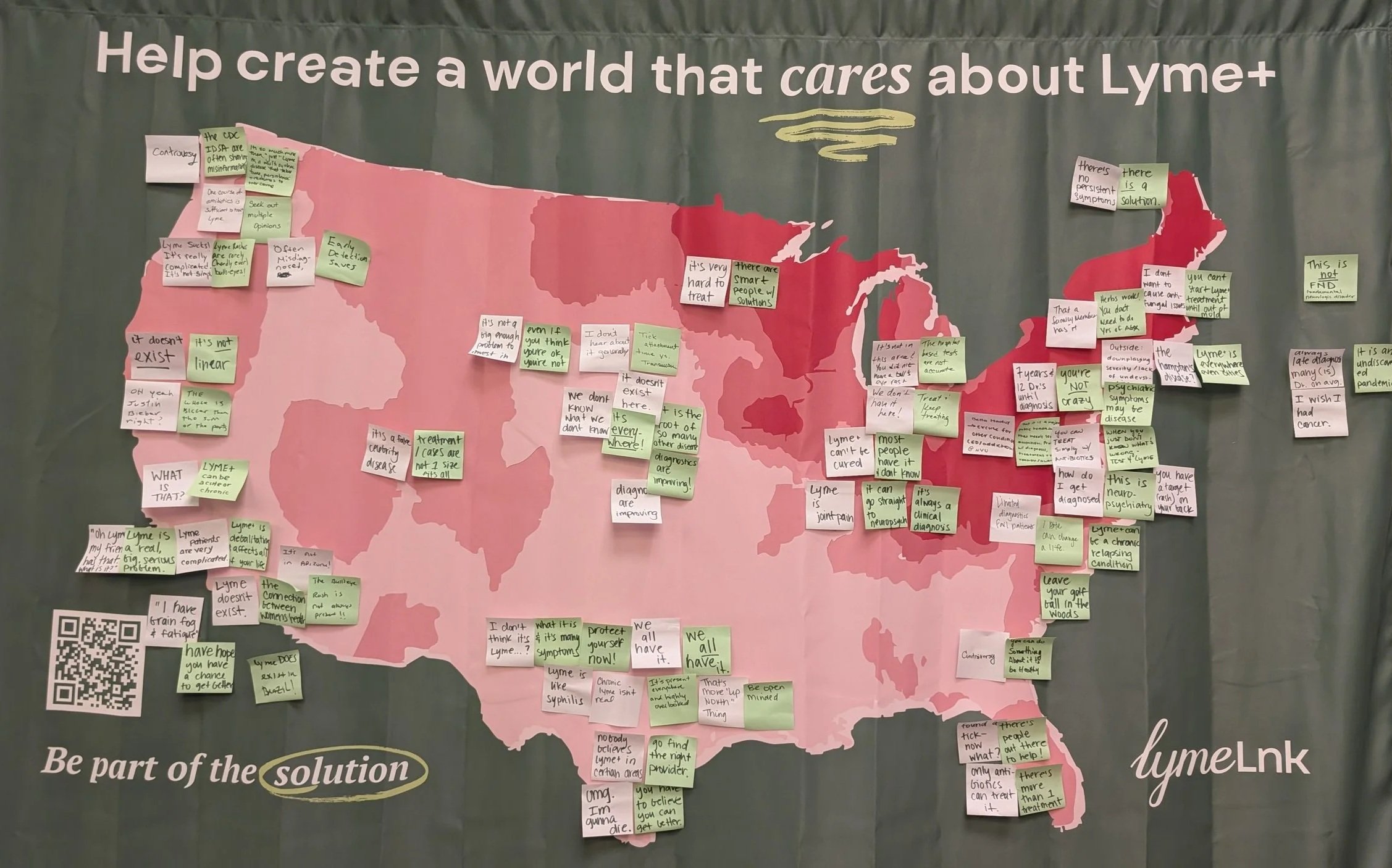
We asked participants to write their answers on sticky notes and place them on a U.S. map, showing where these insights come from geographically.
The status quo: what people hear
The disease doesn't exist — in many forms at once
"Chronic Lyme doesn't exist." "It's not in Arizona." "The 'Hamptons' disease." "Bella Hadid? That's just a cover-up."
Geographic dismissal keeps people from getting tested and diagnosed. Cultural dismissal keeps the public from taking it seriously. Institutional dismissal keeps the disease understaffed, undercounted, underfunded, and underresearched. These aren't separate problems — they are all results of a lack of education and understanding.
A diagnostic system that routinely misses
"7 years and 12 doctors until diagnosis." "15 doctors on average." "I was misdiagnosed.”
This isn't hyperbole. Because the antibody response takes two to three weeks to develop after a tick bite, the standard antibody tests report false negatives for 50–65% of early infections. As a result, the Columbia University Irving Center Lyme & Tick-Borne Diseases Research Center is explicit: Lyme disease is a clinical diagnosis, made through medical history, physical exam, and clinical judgment — not a test result alone.
When it often takes years and multiple clinicians to land a diagnosis, it's not the patient who didn't try hard enough. It's the system that wasn't designed to diagnose them.
The bacteria may actually be affecting your brain
"It's all in your head." "You look fine."
First: patients are routinely dismissed, told their symptoms are psychological or not real. A 2024 Johns Hopkins study of 80 post-treatment Lyme patients found that 49% experienced a lack of understanding from medical professionals, 60% had their symptom severity doubted, and 51% were told their symptoms represented an entirely different condition. Women were significantly more likely to be dismissed. (Rebman et al., Johns Hopkins Lyme Disease Research Center, 2024)
Second: Lyme+ can cause neuropsychiatric symptoms. When bacteria cross the blood-brain barrier, they can trigger neuroinflammation that produces cognitive changes and mood disturbances clinically indistinguishable from psychiatric illness. A 2025 study examined 37 youth diagnosed with pediatric bipolar disorder and found tick-borne infections as a potential contributing factor through this mechanism. Overall, 92% had evidence of tick-borne exposure, with 81% meeting both laboratory and clinical criteria, reframing some psychiatric symptoms as potentially physiological. (Greenberg, PMC12631354, 2025)
Antibiotics: the beginning, not the end
"Antibiotics are sufficient." "Antibiotics are the only treatment.”
Many Western clinicians prescribe a short course of doxycycline, and for patients who respond, that's sufficient. But for the up to 44% who remain ill after treatment, the system offers almost no path forward. Historically, the CDC and IDSA guidelines haven't recognized persistent Lyme as a standalone diagnosis, meaning no billing code, no reimbursement pathway, and no standard of care. Clinicians who try to treat beyond those guidelines face real professional risk — 75% of Lyme-literate physicians report being professionally stigmatized, and 39% have been threatened by medical boards or hospital committees. (Aucott 2022; Johnson 2022, LymeDisease.org)"
The result: clinicians are systematically discouraged from practicing, and patients travel an average of 50–100+ miles to find care, and pay out of pocket, because insurance won't cover it.
The ideal future: what experts want people to know most
Across 50+ responses, three themes emerged with the highest frequency:
"Lyme+ is a public health crisis — and it is everywhere."
Ticks don't respect state lines. Climate is expanding its range. Geographic dismissal is one of the most dangerous myths in this space.
"It can present with neuropsychiatric and other chronic symptoms."
Not a fringe position — the lived reality of a significant patient population, and increasingly supported by research.
"There are solutions. You can get better."
Lyme-literate practitioners exist. Early detection and treatment work. The progress isn't hopeless — it's underreported: a new treatment for persistent neurological symptoms, an AI-assisted diagnostic that can detect infection before antibodies appear, and an antibiotic alternative that treats without disrupting the gut microbiome.
The gap we're working to close
Patients sit with lived experiences. Lyme-literate practitioners and researchers carry this knowledge. Organizations such as Bay Area Lyme Foundation, Global Lyme Alliance, Project Lyme, and LymeDisease.org have funded research and built substantial evidence bases.
It's not the evidence that's missing.
It's the communication.
LymeLnk hopes to use community storytelling and education to close the gap between what Lyme-literate sources show and what society believes. Our work is to listen to these communities, unify their intelligence into an accessible narrative, test to see what resonates, and scale it to the general public. With community collaboration and human-centered design, LymeLnk hopes to create links within the community and to the outside world.
Connect with us to learn more about how that's taking shape and how you can be part of it.
A world that cares starts with you.
